Welsh Terrier Weight, Size & Lifespan
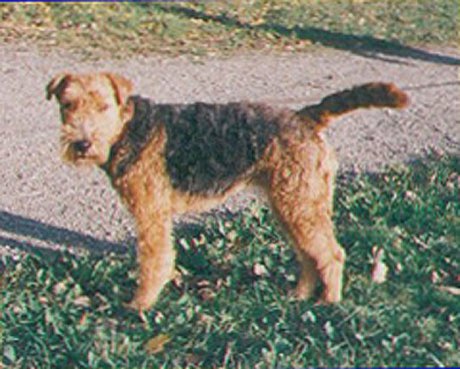

How big does a Welsh Terrier get?
A full-grown Welsh Terrier is a small dog, weighing about 20 lb as an adult.
- Adult weight
- 20 lb
- Also in kilograms
- 9.1 kg
- Size class
- Small
- Life expectancy
- 12–15 years
Wikidata publishes 20–21 lb for this breed. The two sources don’t measure the same thing — see why.
Welsh Terrier Size
As a small breed, a Welsh Terrier reaches its adult weight earlier than a large dog — smaller breeds finish growing sooner (Hawthorne et al., 2004).
Welsh Terrier Lifespan
How long do Welsh Terriers live?
The American Kennel Club publishes a life expectancy of 12–15 years for the Welsh Terrier, on its breed page. That is a figure for the breed, not a prediction for one dog — an individual Welsh Terrier can fall on either side of it.
A second source measured it instead of publishing it. McMillan et al. (2024) followed 570 dogs of this breed in the United Kingdom and recorded 146 deaths, giving a median age at death of 13.8 years (95% CI 13.5–14.6 years).
The two roughly agree here, which is not always the case: on 34 of the breeds on this site the measured median falls outside the range the AKC publishes, in both directions. They are still not the same measurement — a life expectancy for the breed on one side, the age half the studied dogs had died by on the other.
Welsh Terrier Growth Chart
What a Welsh Terrier puppy weighs week by week, from the growth curve FEDIAF publishes (Nutritional Guidelines 2025, Table VII-8a) for a dog whose expected adult weight is 9.1 kg. It is an average, not a target, and it is only valid from 8 weeks to one year — FEDIAF notes that growth patterns show a certain individual variability. Read a row as the middle of a spread.
| Age | Weight | % of adult weight |
|---|---|---|
| 8 weeks | 6 lb (2.6 kg) | 28% |
| 10 weeks | 7 lb (3.3 kg) | 37% |
| 12 weeks | 9 lb (3.9 kg) | 43% |
| 14 weeks | 10 lb (4.5 kg) | 49% |
| 16 weeks | 11 lb (4.9 kg) | 54% |
| 18 weeks | 12 lb (5.3 kg) | 58% |
| 20 weeks | 12 lb (5.6 kg) | 62% |
| 24 weeks | 14 lb (6.3 kg) | 69% |
| 28 weeks | 15 lb (6.8 kg) | 75% |
| 32 weeks | 16 lb (7.2 kg) | 80% |
| 36 weeks | 17 lb (7.6 kg) | 84% |
| 40 weeks | 18 lb (8.0 kg) | 88% |
| 44 weeks | 18 lb (8.3 kg) | 91% |
| 48 weeks | 19 lb (8.6 kg) | 94% |
| 52 weeks | 19 lb (8.8 kg) | 97% |
Common questions
How much does a full-grown Welsh Terrier weigh?
A Welsh Terrier weighs about 20 lb (9–9.5 kg) as an adult. That figure is the weight the American Kennel Club publishes in the breed's official standard, re-checked here every week — it is a typical weight across many adult dogs, not a target for one dog. Wikidata publishes 20–21 lb for the same breed — a breed standard and a set of measurements don't answer the same question, so this page names both rather than picking one.
Is a Welsh Terrier a small dog?
Yes — a Welsh Terrier counts as a small breed, going by its published adult weight (9–9.5 kg). The cut-offs between small, medium, large and giant are a common veterinary convention rather than one official standard, so a breed near a boundary can be described either way elsewhere.
When does a Welsh Terrier stop growing?
Earlier than a large dog. Hawthorne et al. (2004) measured that smaller breeds finish growing sooner, so a Welsh Terrier reaches something close to its adult weight before a big breed would. We don't publish a month-by-month figure, because no source gives one breed by breed — and an invented number would be worse than none.
Why is there one weight instead of a range?
Because that is what the source publishes for this breed — a single adult mass, not a span. Real Welsh Terriers still vary with sex, genetics, build and health, so read about 20 lb as the middle of a spread this source does not put numbers on. We don't invent the edges.
How long do Welsh Terriers live?
The American Kennel Club publishes a life expectancy of 12–15 years for the breed, re-checked here every week. That is a figure for the breed, not a prediction for one dog: an individual Welsh Terrier can fall on either side of it, and how a dog is fed, exercised and cared for moves the odds. A second source measured it rather than publishing it: McMillan et al. (2024) followed 570 dogs of this breed in the United Kingdom, recorded 146 deaths, and report a median age at death of 13.8 years (95% CI 13.5–14.6 years).
Breeds of a similar size
Every dog calculator
- Dog Age Calculator — Your dog’s age in human years, the science-based way
- Puppy Weight Calculator — How big will your puppy get, by breed
- Dog Pregnancy Calculator — Your dog’s due date from her mating date
- Dog Calorie Calculator — How many calories your dog needs a day
- Dog Chocolate Toxicity Calculator — How much chocolate is dangerous for your dog, by weight
- Puppy Feeding Calculator — How much to feed a puppy, by weight and age
- Dog Benadryl Dosage Calculator — How much Benadryl you can give a dog, by weight
- Puppy Vaccination Schedule — Puppy shots by age, from the AAHA’s published guidelines
Weight varies within the Welsh Terrier by sex, genetics and health, and mixed-breed dogs fall between their parents. This is a typical range, not a guarantee.
Verified on . Based on Wikidata — dog breed mass (property P2067) (Wikimedia Foundation, query run 2026-07-22, CC0 license), Breed weights — official AKC breed standards (American Kennel Club, breed pages, accessed 2026-07-29), Breed life expectancy — AKC breed pages (American Kennel Club, breed pages, accessed 2026-08-10), Longevity of companion dog breeds: those at risk from early death — Supplementary Table S3 (McMillan et al., Scientific Reports (2024), 14:531, 584,734 UK dogs — Kaplan-Meier median survival for 155 breeds), Body-Weight Changes during Growth in Puppies of Different Breeds (Hawthorne et al., Journal of Nutrition, 2004, vol. 134, p. 2027S) and Nutritional Guidelines for Complete and Complementary Pet Food for Cats and Dogs (FEDIAF (European Pet Food Industry Federation), 2025 edition (growth curves Table VII-8a, growth energy VII-8b and VII-10)). See the method.